
Whole-building filtration matched to a lab test
Point-of-entry filtration and softening for a home or small building, chosen from a certified lab test and specified by NSF/ANSI certification.
For: Homeowners on city water or a private well, and owners of small buildings
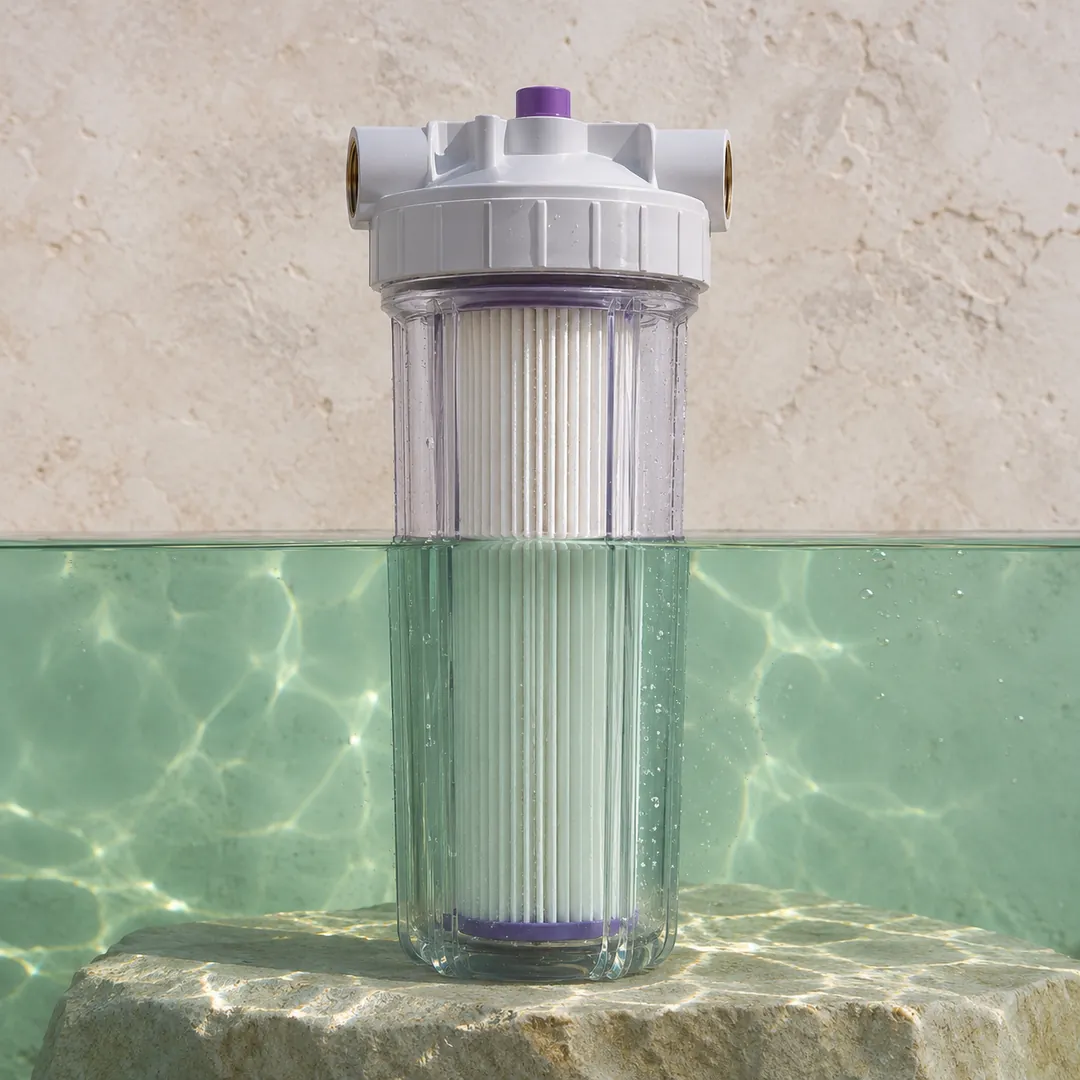
Whole-building treatment, also called point-of-entry treatment, sits where the water service enters the building: after the meter on city water, or after the pressure tank on a private well. Every gallon that reaches the taps, showers, water heater and appliances passes through it. It fits problems that show up everywhere in the building, such as scale, iron staining, sediment or a taste in every tap. It is the wrong tool for some problems, which is why Maredes designs it only after a laboratory test shows what is in the water.
When it fits
- Hardness. Calcium and magnesium leave scale in water heaters, on fixtures and inside equipment. Hardness is not on EPA’s lists of drinking water standards, so the decision rests on the lab result and on what the scale costs you.
- Iron and manganese. EPA’s secondary standards, which are non-enforceable guidelines for taste, odor and appearance, are 0.3 mg/L for iron and 0.05 mg/L for manganese. Above them, water can stain laundry and fixtures. On November 22, 2026, JXN Water’s home page carried a notice that “Seasonal changes have caused an increase in manganese.” Check your utility’s own pages for current information.
- Sediment and cloudiness that clog aerators and appliance screens.
- Taste and odor from chlorine on city water, or from a well.
- Private wells. EPA notes that private wells are not regulated by the federal government under the Safe Drinking Water Act, and the Mississippi State Department of Health tests private wells “for bacteriological contamination only”; minerals and chemicals go to a private laboratory. MSU Extension, using MSDH data for fiscal 2018, counted about 382,398 Mississippians (12.81 percent) on private wells.
What it does and does not do
Each stage handles some problems and not others. This summary follows CDC’s household treatment guidance and the treatment selector.
| Stage | Addresses | Does not address |
|---|---|---|
| Sediment filter | Sand, silt and particles | Dissolved metals, chemicals, microbes |
| Activated carbon | Chlorine taste and odor (NSF/ANSI 42 claims) | Hardness; fouls quickly with iron |
| Water softener (NSF/ANSI 44) | Calcium and magnesium; low dissolved iron | Microbes; lead picked up inside the building |
| Iron and manganese filter | Iron and manganese, after oxidation | Microbes, hardness |
| UV unit (NSF/ANSI 55) | Bacteria, viruses and parasites, after pre-filtration | Chemicals and metals |
Two limits matter most. First, lead: EPA says the most common sources of lead in drinking water are lead pipes, faucets and fixtures, and some of those sit downstream of any point-of-entry system. For lead, we specify a unit at the tap certified to NSF/ANSI 53 for lead reduction, covered under drinking water systems. Second, certification is claim-specific. A unit listed under NSF/ANSI 42 for chlorine reduction is certified for that claim, not for others its listing does not show, so we check each claim in the certifier’s listing.
How Maredes designs it
Inputs
We start from the lab results and the water review: which contaminants, at what levels, from which source. Then we measure demand: daily gallons from the bills or meter, and peak flow from the fixture count, because a filter sized for the average day can cut pressure when two showers and the washer run together. We note the service size and pressure, the space near the service entry (a garage wall, a closet, a mechanical room or a pad outside), and whether a drain and an outlet are close enough for backwash and regeneration. On a well, we read the well log and look at the pump and pressure tank.
Sizing
A softener is sized from hardness, iron and daily softened water, which the softener sizing calculator lets you try. Cartridges are sized from rated capacity and daily flow, as in the filter life calculator. Outdoor taps and a separate drinking-water line are often left unsoftened.
Specification
The specification names the certification each component must carry, not a brand: NSF/ANSI 42 for aesthetic claims, 44 for softeners, 53 for health-effects claims, 55 for UV. Valves, fittings and pipe in contact with drinking water must carry NSF/ANSI/CAN 61 or 372 marks; EPA notes that 372 certification “indicates that a product complies with EPA’s lead free requirements”. We add a bypass valve, sample ports before and after treatment, and pressure gauges across the filters so a loading cartridge shows up as a pressure drop.
Installation
A licensed plumbing contractor installs the system. The Mississippi State Board of Contractors’ Plumbing classification covers public and private water supply systems. In Jackson, the city states that property owners or licensed contractors obtain required permits before work begins. Other cities and counties set their own rules.
Example (fictional). The Tolliver household is a fictional family of four in a house on a private well. Their lab report shows iron at 0.6 mg/L and manganese at 0.08 mg/L, both above EPA’s secondary standards, hardness of 150 mg/L as calcium carbonate (8.8 grains per gallon), pH 6.8, and total coliform and E. coli absent. These are the values in the water test reader’s default example. The design compares an iron and manganese filter ahead of a softener with a softener alone handling the iron, within each manufacturer’s stated limits. Entered in the softener sizing calculator at 70 gallons per person per day, with a 32,000-grain softener and one day of reserve, the result is a compensated hardness of 11.2 grains per gallon, 3,136 grains removed a day, regeneration every 9 days and 41 regenerations a year. The kitchen tap is reviewed separately. All figures are planning assumptions.
What you provide and receive
You provide the lab results, or a water review that produces them; a recent bill or meter readings; for a well, the well log and the pump and pressure tank details; photos of or access to the service entry; and your choice of licensed plumber, or a request for bids.
You receive a treatment schematic, an equipment specification naming the certification of each component, the sizing calculations, installation notes for the plumber, a start-up and verification sampling plan compared with your baseline results, and a maintenance schedule.
Maintenance
EPA’s filter fact sheet puts it plainly: “Filters are only effective if they are maintained.” Cartridges are changed at their rated gallons or months, whichever comes first. Softener salt is topped up and settings are checked after any new hardness test. UV lamps are replaced on the manufacturer’s schedule. Every change goes into a maintenance log, and a service plan can take this on for you. Well owners can use the private well checklist for the yearly tests.
Start with a water review.
Tell us about the building: what it is, who uses it, where the water comes from and what you would like to change. We reply with questions and a time to walk the building with you.