
How a Maredes system works
Water treatment and reuse, designed for one building. It starts with a lab test of your water, and every stage after that has one job it can do and several it cannot.
For: Owners and managers weighing filtration or water reuse for one building
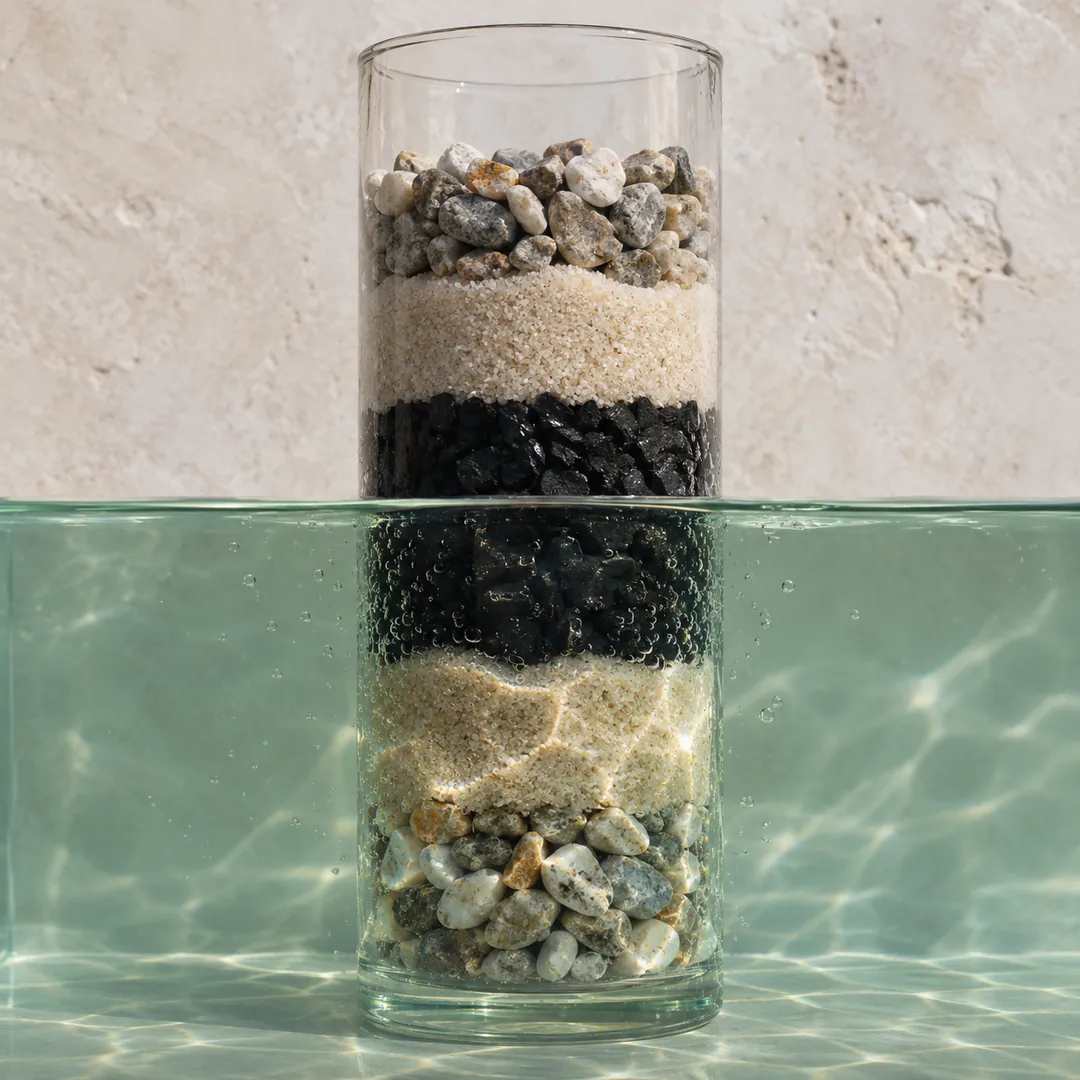
A Maredes system is a short row of equipment in which each part has one job. On the drinking water side, it treats water from the city or a private well before it reaches a tap, an ice machine or the whole building. On the reuse side, it gives water the building has already paid for (laundry rinse water, air-conditioning condensate, rain from the roof or greywater) a second, non-potable use. Which stages a building gets depends on a certified laboratory test of its water and on its own bills, not on a standard package.
Two kinds of system
Treatment for the water you drink and use. A point-of-entry system sits where the service line enters the building and treats everything downstream. A point-of-use system serves one place: a kitchen tap, a break room, an ice machine or a coffee line. Many buildings need only one of the two. See whole-building filtration and drinking water systems.
Reuse for water that would otherwise leave. A reuse system collects one source of water, treats it for one non-potable use and keeps it apart from the drinking water piping. Reused water flushes toilets, irrigates, tops up a cooling tower or rinses the next load of laundry. It is never used for drinking, cooking or bathing.
The five treatment stages
1. Sediment
A cartridge or media filter that catches sand, silt, rust and scale particles, rated by the size of particle it stops. It goes first because it protects everything after it: carbon fouls more slowly, membranes last longer and UV light reaches the water. It removes particles only. Dissolved metals, chemicals and microbes pass straight through.
2. Carbon
Activated carbon, as loose granules or a pressed block. What a given carbon unit reduces depends on what it is certified for. In NSF’s listings, units under “Drinking Water Treatment Units, Aesthetic Effects” (NSF/ANSI 42) carry claims such as chlorine reduction, chloramine reduction and taste and odor reduction; units under “Drinking Water Treatment Units, Health Effects” (NSF/ANSI 53) carry claims such as lead reduction, cyst reduction or PFOA and PFOS reduction, product by product, as the NSF listings show. Carbon is not a disinfection step, and it does not soften water.
3. Membrane
At a drinking water tap this is usually reverse osmosis, listed by NSF as “Reverse Osmosis Drinking Water Treatment Systems” (NSF/ANSI 58). The CDC says reverse osmosis removes parasites, bacteria and viruses and some chemicals, including lead, copper, chromium, chloride and sodium, and advises checking the label for the specific chemicals a system removes. It also sends water to the drain: EPA WaterSense notes that a typical point-of-use unit makes five gallons or more of reject water for every gallon of treated water. Reuse systems more often use ultrafiltration, which the CDC says removes parasites and bacteria but not chemicals.
4. Ultraviolet
A UV lamp inside a stainless steel chamber, listed as “Ultraviolet Microbiological Water Treatment Systems” (NSF/ANSI 55). NSF’s listings give each unit a rated flow in gallons per minute and a claim of Class A or Class B disinfection performance, so the specification names both. The UV light inactivates microorganisms in water that is already clear; it does not remove chemicals, metals or particles, which is why it sits after sediment and carbon. UV treats water as it passes the lamp and leaves nothing behind in it, so stored water is treated on its way out of the tank, not only on its way in.
5. Monitoring
Pressure gauges on each side of a filter housing, a meter on the treated line, a UV intensity sensor and lamp-hour counter, a conductivity reading after a reverse osmosis membrane, a level sensor in each tank and, for reuse, turbidity readings and periodic laboratory samples. Monitoring removes nothing. It shows when a cartridge is loaded, a lamp is weak or a membrane is passing more than it should. EPA’s advice on home filters applies to every stage: “Filters are only effective if they are maintained.”
Softening, when the test calls for it
A softener (NSF/ANSI 44, “Cation Exchange Water Softeners”) is added only when a hardness result justifies it. Size one with the softener sizing calculator and your own test result.
What each stage removes and does not remove
| Stage | What the specified equipment carries | What it addresses | What it does not address |
|---|---|---|---|
| Sediment | A particle size rating; NSF/ANSI 42 where a particulate claim is listed | Sand, silt, rust and scale particles | Dissolved metals, chemicals, bacteria, viruses |
| Carbon | NSF/ANSI 42, 53 or 401, for the claims on its listing | Chlorine or chloramine, taste and odor, and any health claim on its listing | Microbes (it is not disinfection), hardness, contaminants not on its listing |
| Reverse osmosis | NSF/ANSI 58 | Per CDC: parasites, bacteria, viruses and some chemicals such as lead, copper and sodium | Chemicals not on its listing; it also produces reject water |
| Ultrafiltration | A rating from the maker; used mainly in reuse | Per CDC: parasites and bacteria | Chemicals |
| Ultraviolet | NSF/ANSI 55, Class A or B | Disinfection of microorganisms to its listed class; works on clear, pre-filtered water | Chemicals, metals, particles; nothing remains in the water after the lamp |
| Softener | NSF/ANSI 44 | Hardness minerals (calcium and magnesium) by ion exchange | Parasites, bacteria, viruses |
| Monitoring | Gauges, meters, sensors, lab samples | Nothing; it shows when a stage needs service | Everything; it is a check, not a treatment |
Certification is claim-specific. A unit listed under NSF/ANSI 53 for lead reduction is not certified for every contaminant that standard covers, so each line of a Maredes specification names the claim and is checked against the certifier’s listing. The standards page lists every standard Maredes specifies, and the treatment selector matches one water problem to the treatment that addresses it.
The reuse loop
Every reuse system follows the same five steps: collect one source, treat it for one use, store it for as long as the use requires and no longer, reuse it through separate piping, and monitor it for as long as it runs.
| Source | Collect | Treat | Store | Reuse |
|---|---|---|---|---|
| Laundry rinse water | Final rinse from washer extractors | EPA says simple recycling “rarely needs treatment”; complex recycling of wash and rinse water usually does | Hours, until the next load | The first rinse of the next load |
| Air-conditioning condensate | Drain lines from air handlers | Filtered and disinfected wherever people can touch or breathe it (EPA) | A tank, often shared with rain | Cooling tower make-up, irrigation |
| Rainwater | Roof drains and downspouts | Screening, filtration and UV for uses near people | Days to weeks, between storms | Irrigation, cooling make-up, toilet flushing where approved |
| Greywater | Separate drains from showers, baths and bathroom sinks | A unit listed under NSF/ANSI 350 in the class that fits, plus disinfection for indoor use | As short as possible | Toilet and urinal flushing, subsurface irrigation |
EPA WaterSense at Work puts condensate at three to 10 gallons per day per 1,000 square feet of air-conditioned space, low in minerals but able to grow bacteria. A roof yields about 0.62 gallons per square foot per inch of rain, and most installers assume 80 percent capture. Simple laundry rinse recycling saves 10 to 35 percent of laundry water, and complex recycling can save more than 80 percent (EPA). Greywater never includes toilet or kitchen sink water, and EPA advises consulting local health department officials first. Try your own numbers in the rainwater, condensate and greywater calculators.
Safeguards in every reuse design
- Separate, labeled piping. The DOE notes that reclaimed water pipes must be color coded with purple tags or tape according to American Water Works Association standards.
- Backflow protection. City or well make-up water enters a reuse tank through an air gap or a backflow preventer, so reuse water cannot reach the drinking water supply.
- Disinfection indoors. EPA recommends disinfection for all water used indoors for toilet flushing or other uses.
- Overflow and drain on every tank, and a plan for the building’s water management program team.
- A code path memo. Mississippi has no state greywater or onsite reuse rule, so approval is project by project with the local building official and, where wastewater is involved, the health department.
Where the equipment sits
Components are bought from manufacturers to a written specification and mounted as a compact rack or skid. A point-of-entry rack sits where the service line enters the building: on a garage wall, in a mechanical room or closet, or on a pad outside. Point-of-use units fit under a sink or beside an ice machine. Reuse tanks go where the water arrives: near the laundry for rinse water, near the air handlers and downspouts for condensate and rain. Each location needs a drain, power for pumps and UV lamps, and room to change cartridges. The water review records the space before design starts; how we work explains each step, and the example project follows one building through all of them.
Start with a water review.
Tell us about the building: what it is, who uses it, where the water comes from and what you would like to change. We reply with questions and a time to walk the building with you.