
Water filtration for homes on city water or a well
Two houses on the same street can need different equipment, or none. The way to know is a certified laboratory test of the water at your own tap.
For: Homeowners on city water or a private well in Mississippi
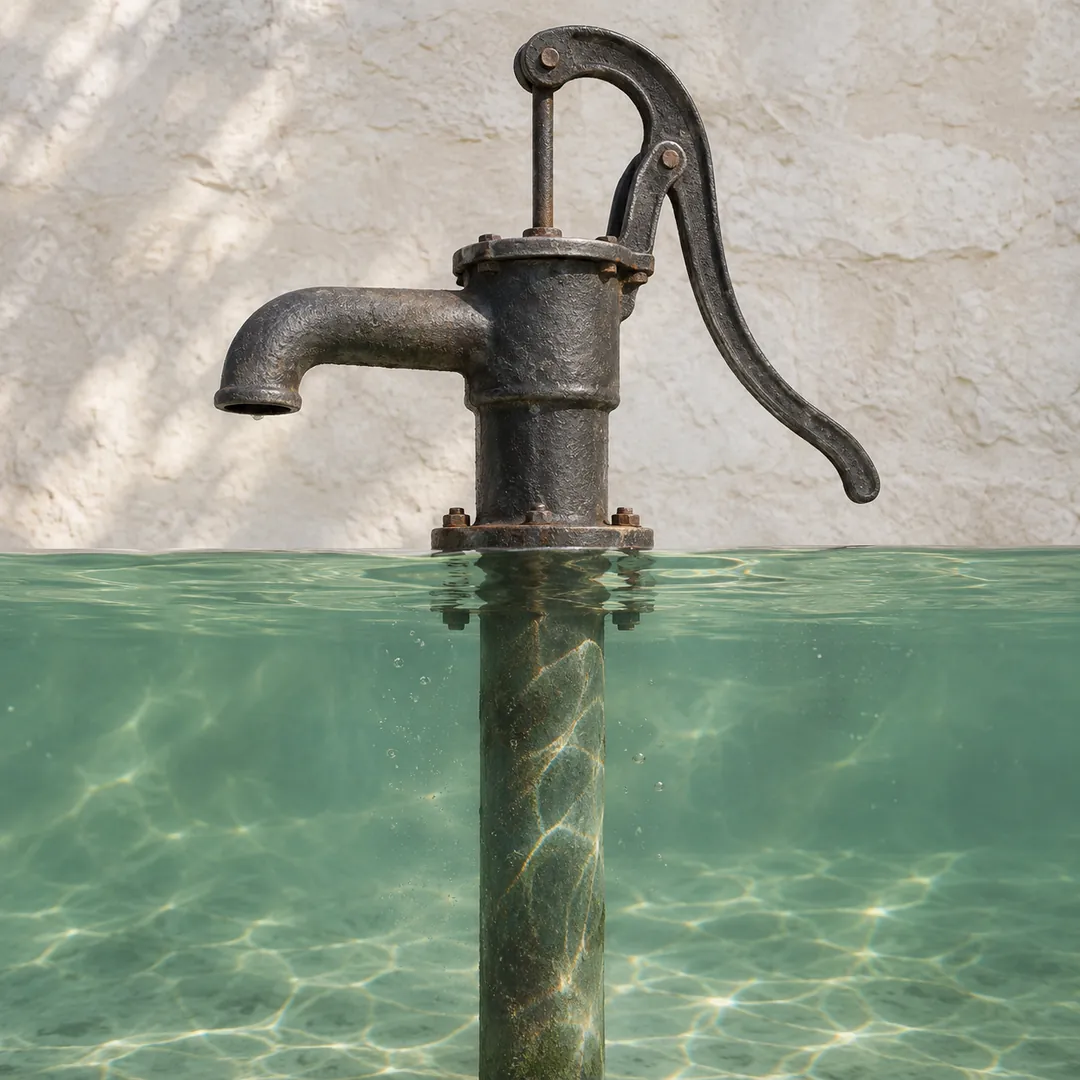
It is easy to buy home water treatment before knowing what is in the water. Maredes works the other way round. A certified laboratory tests your tap water, equipment is chosen to match the results and certified for the claim it must meet, and a licensed plumbing contractor installs it. Sometimes the answer is a kitchen filter and a habit. Sometimes it is nothing at all, and the review says so.
On city water: the utility’s report and your own pipes
Every community water system must publish a Consumer Confidence Report each year by July 1, listing what it detected. It describes the water in the utility’s plant and mains, not the service line from the meter to your house or the pipes, faucets and fixtures inside it, which the EPA names as the most common sources of lead in drinking water. In Jackson, JXN Water notes that the owner owns the line between the meter and the house.
- Lead. EPA says “testing is the only sure way” to know about lead, and that boiling does not remove it. JXN Water’s 2025 Water Quality Report gives 90th percentile lead results of 4.5 ppb (January to June 2025) and 4.1 ppb (July to December 2025), below the 15 ppb action level, and counts 32,527 service lines of unknown lead status in its September 2025 inventory. For water systems, the action level falls to 10 ppb on November 1, 2027.
- MSDH guidance for Jackson. MSDH’s Jackson Water System page recommends running the cold tap for one to two minutes, never using hot tap water for drinking or cooking, cleaning faucet aerators, and filtered water (an “NSF53 certified filter”) or bottled water for children five and under and pregnant women. Check that page for its current guidance.
- Taste, color and staining. Iron, manganese, dissolved solids and pH fall under EPA’s secondary standards, non-mandatory guidelines such as 0.3 mg/L for iron and 0.05 mg/L for manganese. On November 22, 2026, JXN Water’s home page carried a notice that seasonal changes had caused an increase in manganese.
- Boil-water notices. Check JXN Water and MSDH for current notices. The boil-water notice checklist covers what to do during and after one, including which filter cartridges to replace.
On a private well: you are the water system
Private wells are not regulated under the Safe Drinking Water Act nor by most state governments, as the EPA explains, and EPA cites a USGS study of 2,100 wells in which about one in five had a contaminant above a human-health benchmark. Using MSDH data for fiscal 2018, MSU Extension counted 382,398 Mississippians on private wells, 12.81% of the state, including 24,413 people in Hinds County.
MSDH tests private wells “for bacteriological contamination only”; minerals, chemicals and other contaminants go to a private laboratory, and MSDH publishes a list of certified laboratories. MSDH also explains how to disinfect a well after a flood or repair, and when to call a licensed water well contractor. Maredes does not drill, repair or disinfect wells; it plans testing and treatment.
A typical well panel covers total coliform and E. coli, nitrate (EPA’s limit is 10 mg/L as nitrogen), arsenic (0.010 mg/L), iron, manganese, hardness and pH. The private well checklist sets out how often to test and what to check around the wellhead.
Which services fit, and in what order
- Water review and lab test. Bills or the well log, a walk from the meter or wellhead to the water heater, and kitchen tap samples, first-draw where lead is the question.
- Drinking water at the kitchen tap. For lead, a point-of-use filter certified under NSF/ANSI 53 for lead reduction, or a reverse osmosis unit certified under NSF/ANSI 58 with a lead claim. WaterSense notes that a typical point-of-use RO system sends five gallons or more of reject water down the drain for every gallon treated, so RO is specified only where the results call for it. See drinking water systems.
- Whole-house treatment for what affects every tap: sediment, chlorine taste and odor (NSF/ANSI 42), hardness (softeners under NSF/ANSI 44), iron and manganese, and UV (NSF/ANSI 55) for a well where bacteria remain a concern after the source is repaired. See whole-building filtration.
- Monitoring and service. EPA’s filter fact sheet: “Filters are only effective if they are maintained.” The filter life calculator default, a 750-gallon cartridge drawing 3 gallons a day with a six-month limit, gives “Replace every: 182 days (about 6.0 months)”, limited by time in service.
- Reuse, if any. Rainwater for a garden is the simplest reuse at home. NSF lists a few greywater systems for single-family homes (Class R), but Mississippi has no state greywater rule, so a home system needs local approval, project by project. Fixing leaks and fixtures usually comes first.
Example: a well report with two results above a guideline
Example (fictional). The water test reader opens with a fictional laboratory report for a private well. It shows “Results above a reference value: 2 of the values entered”: iron at 0.600 mg/L against a 0.3 mg/L secondary standard, and manganese at 0.080 mg/L against 0.05 mg/L. Total coliform and E. coli are absent, nitrate is 2.1 mg/L against a 10 mg/L limit, lead is 3.0 ppb, and hardness is 150 mg/L as calcium carbonate (8.8 grains per gallon). Maredes would retest iron and manganese before specifying anything, then compare a whole-house iron and manganese filter with doing nothing, since both exceed only EPA’s non-mandatory secondary standards. Bacteria and nitrate tests would continue every year either way. All values are fictional.
What you provide and what you receive
You provide: twelve months of water bills, or for a well the well log, its depth and any past tests; any utility letters or notices; what you notice (stains, taste, odor, scale) and where; access to the meter or wellhead, the water heater and any existing equipment; and a decision on the licensed plumbing contractor.
You receive: the laboratory’s report with each result explained in plain language beside the limit or guideline that applies; findings in order of cost, including “do nothing” where the results support it; for equipment, a specification naming the NSF/ANSI certification each unit must carry; a start-up sample compared with the first test; and a maintenance log. Maredes gives no medical advice; for a result above a limit, it tells you who to call.
Start with a water review.
Tell us about the building: what it is, who uses it, where the water comes from and what you would like to change. We reply with questions and a time to walk the building with you.