
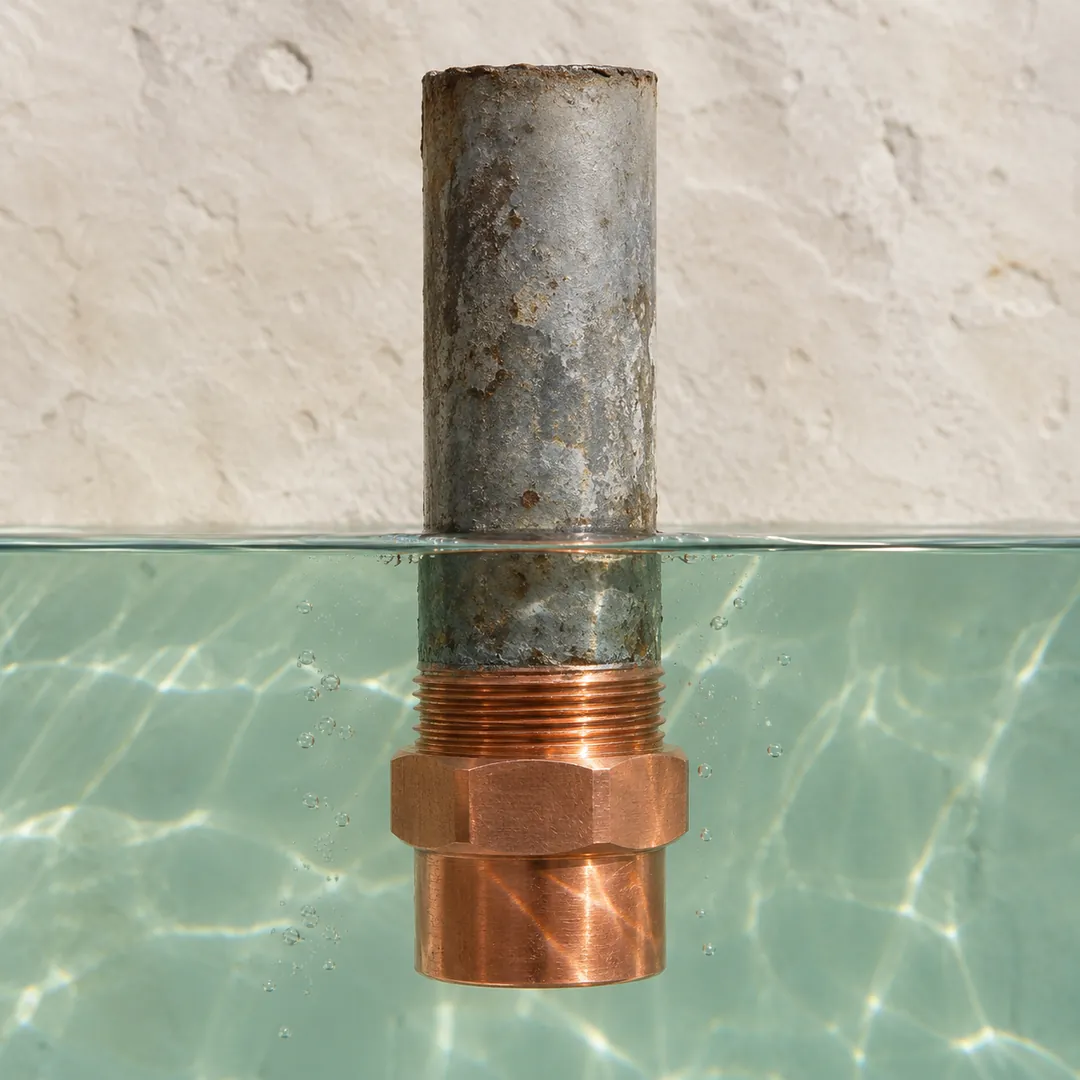
To tell if you have lead pipes, start with your water utility’s service line inventory, then find the pipe where it enters your building and check it the way EPA’s Protect Your Tap guide describes: gently scratch it with a key or coin and hold a magnet to it. If the scratch shows gray metal that is soft and the magnet does not stick, it may be lead; orange like a penny is copper, hard gray metal that attracts a magnet is galvanized steel, and plastic is not a source of lead. Lead can also come from solder, brass faucets and galvanized pipe that once sat downstream of a lead line, so EPA says testing your water at a certified laboratory is the only way to confirm it. If you find lead, call the utility about replacement, use only flushed cold water for drinking and cooking, and use a filter certified to reduce lead until the pipe is gone.
For many owners in Jackson the inventory is not the end of the question. JXN Water’s September 2025 inventory lists 32,527 lines on the surface water system as “unknown” lead status, so a scratch test, a plumber’s look or a laboratory result is often the first real information about a building. This guide covers each check in order, what the Lead and Copper Rule Improvements change, who owns which part of the pipe, and how to protect a household while you wait. Facts were checked at their sources on November 22, 2026.
Where lead can hide in a building’s water pipes
Lead can enter tap water at four places: the service line from the street, the short connector at the main, solder joints on copper pipe, and brass valves and faucets. Galvanized steel pipe can also hold lead it picked up from a lead line upstream. Knowing these places tells you where to look.
EPA’s Protect Your Tap guide says that in homes served by a lead service line, “the service line is the most significant source of lead in drinking water.” Its diagram notes that goosenecks and pigtails, the “shorter pipes that connect the lead service line to the main,” can contain lead too. Inside the building, it lists copper pipe joined with lead solder before 1986, fixtures containing lead, and galvanized pipe that has collected lead particles on its inside surface.
EPA’s lead basics page adds two points. Lead pipes “are more likely to be found in older cities and homes built before 1986,” and “among homes without lead service lines, the most common problem is with brass or chrome-plated brass faucets and plumbing with lead solder.” Corrosion drives all of it, “especially where the water has high acidity or low mineral content,” and the guide says it “happens more readily with hot water.”
Dates that narrow the search
A building’s age tells you which of these to expect. EPA’s lead-free page explains that in 1986 Congress prohibited pipe, solder or flux that was not “lead free” in public water systems and in plumbing that provides drinking water. At the time, “lead free” allowed up to 0.2 percent lead in solder and flux and up to 8 percent in pipes.
MSDH’s service line inventory page says states were required to enforce that ban by June 1988. JXN Water’s lead page likewise says lead-based solder on copper pipes was “used until 1988.” In 2011, Congress lowered the limit for pipes, fittings and fixtures to a weighted average of 0.25 percent lead across wetted surfaces.
| Built or replumbed | What to expect | Where to look first |
|---|---|---|
| Before 1986 | Lead service lines and connectors possible; lead solder on copper possible; older brass faucets | The service line where it enters, solder joints, faucets |
| 1986 to 1988 | Ban in effect, but states had until June 1988 to enforce it; lead solder still possible | Solder joints and faucets |
| After 1988 | MSDH says utilities may record the service line as non-lead | Faucets and valves; “lead free” brass before the 2011 change could contain more lead than today’s limit |
| Any age with galvanized pipe | Galvanized pipe can hold lead picked up from a lead line upstream | The service line material and the inventory record |
Step 1: Check your utility’s service line inventory
Every community water system has had to build an inventory of service line materials and make it public. Read yours first, because it may already answer the question for the part of the line you cannot see.
MSDH’s inventory page says public water systems “must identify and make public the locations of lead, non-lead, and unknown service lines,” and that community and non-transient non-community systems had to submit inventories to its Bureau of Public Water Supply by October 16, 2024. EPA’s LCRI questions and answers adds that the inventory covers “the material and location of service lines and connectors,” must be “publicly accessible,” and that systems must notify people served by a lead line, by a galvanized line that may be contaminated by lead, or by a line of unknown material.
What each inventory category means
| Category | What it means | What to do |
|---|---|---|
| Lead | Some part of the service line is lead | Ask the utility about its replacement plan; flush, use cold water, consider a certified filter, test |
| Galvanized requiring replacement (GRR) | Galvanized iron or steel that is, or was, downstream of a lead line | Treat it like lead for flushing and filters; ask about replacement |
| Lead status unknown | The utility has no record of the material | Do the scratch and magnet test, ask a licensed plumber, report what you find |
| Non-lead | Records or inspection show a material other than lead or GRR | Lead can still come from solder and faucets; test if your plumbing is older |
Sources: JXN Water lead page (category names and the GRR definition); MSDH inventory page; EPA LCRI questions and answers.
JXN Water’s lead page explains that “service lines made of galvanized iron or steel that are (or were previously) downstream of lead service lines are classified as galvanized requiring replacement (GRR).” EPA’s guide gives the reason: galvanized pipes “can trap lead on their inside surface and periodically release those bits of lead, even after lead plumbing is removed,” and “some galvanized steel pipes have been lined with lead.”
What Jackson’s inventory shows
JXN Water’s 2025 Water Quality Report summarizes the inventory as updated in September 2025:
| System | Galvanized requiring replacement | Unknown lead status | Non-lead | Total lines |
|---|---|---|---|---|
| Surface water system (PWS MS0250008) | 93 | 32,527 | 30,449 | 63,069 |
| Maddox Road groundwater system (PWS MS0250012) | 3 | None listed | 11,768 | 11,771 |
The report lists no lines in the lead category. About 52 percent of the surface system’s lines are of unknown status. JXN Water’s quarterly report for July to September 2026 adds that, “based on preliminary inventory data, Jackson has approximately 13,000 galvanized service lines,” that there are no records showing those lines were ever downstream of lead piping, and that they “may require replacement” under the Lead and Copper Rule Improvements. Replacement “will be deferred until funding is available.”
To see your own record, open the map on JXN Water’s lead page and type your address. The inventory records both the utility side and the private side. JXN Water says the information “is based on the best available data,” that it is “continuously updating it,” and that if the record does not match your property, or you need help identifying the material, you can call 601-500-5200.
Reading the two sides together
The record for each side can differ, and the combination decides what to do next. Because the utility side is buried and the private side is usually visible at the entry point, your own check fills the gap the records leave.
| Utility side shows | Private side shows | What it means | Next step |
|---|---|---|---|
| Non-lead | Non-lead | No lead service line on record | Lead can still come from solder and faucets; test if plumbing predates 1988 |
| Non-lead | Unknown | Your side has no record | Do the scratch and magnet test at the entry point and report the result |
| Unknown | Unknown | Neither side has a record | Scratch test your side, call the utility, test the water |
| Unknown or non-lead | Lead or GRR | Lead or GRR on your side | Get a plumber’s assessment and ask the utility how its plan treats the private side |
| Lead or GRR | Non-lead | Lead or GRR on the utility side | Ask when replacement is scheduled; flush, use cold water and filter until then |
| Lead or GRR | Lead or GRR | Lead or GRR on both sides | Coordinate one replacement of both sides with the utility |
A record can be wrong in either direction, so a scratch result that disagrees with the map is worth reporting. JXN Water asks customers to call if the inventory “does not accurately reflect your property.”
If your utility is not JXN Water, ask it the question EPA’s guide scripts for residents: does it know where lead service lines are, is one connected to your building, and does it offer lead testing. MSDH also notes that a utility may record homes built after 1988 in Mississippi as not having a lead service line.
Step 2: Find where the service line enters your building
The scratch test only works on pipe you can see, so the next job is finding the service line inside. EPA’s guide starts at the water meter, because the line runs from the meter to the building.
The guide says the meter may be inside, “in the basement, crawlspace, or garage,” or outside, “near your home between the main and the house, on the sidewalk, or in the yard.” Then:
- If the meter is outside, look for the line where it enters the building nearest that spot.
- If the meter is inside, the line should be near it on the same wall.
- If you cannot find the meter, check the basement or first floor along the exterior walls, “particularly on the side of the building facing the street.”
- Look for a valve. The incoming pipe comes through an exterior wall or the floor, and “you should see a valve on it.”
- Note the spot. EPA’s photo marks the section of pipe close to where it comes through the wall or floor as the place to scratch.
If the line enters through a crawlspace, plan for a flashlight and safe access. If you cannot reach the pipe, EPA and JXN Water both point to a licensed plumber, who “may be able to assess your faucets, fixtures, and service line for lead,” in JXN Water’s words.
What you see inside is only the private side. The utility side runs underground from the meter to the main and can be a different material, which is why the inventory record for both sides matters.
Step 3: Do the scratch and magnet test
You need a key or a coin and any magnet. EPA’s guide says to “gently scratch the pipe you found close to where it comes in through the wall or floor and look at what color it is,” then test gray metal with the magnet.
| What you see | Magnet | Likely material | What EPA’s guide says |
|---|---|---|---|
| Orange or pale orange under the scratch, “like a penny” | Does not stick | Copper | “Copper is not a source of lead in drinking water,” but lead may be elsewhere in the plumbing |
| Gray, hard to scratch | Sticks | Galvanized steel | Can trap lead from upstream and release it; some was lined with lead |
| Gray, soft and easily scratched | Does not stick | Possibly lead | “If your pipe can be easily scratched and a magnet doesn’t stick to it then it may be made of lead” |
| Plastic | Does not apply | Plastic | “Plastic is not a source of lead in drinking water,” though other plumbing may contain lead |
Source: EPA, Protect Your Tap: A Quick Check for Lead, checked November 22, 2026.
A few practical notes keep the result honest:
- Scratch gently and only enough to see bare metal. The goal is a look at the color, not a groove.
- Check both sides of the valve if you can. A past repair may have joined two materials, and a copper stub at the valve can hide an older pipe beyond it.
- Test bare pipe, not paint or insulation. A coat of paint or a foam sleeve hides the color and keeps a weak magnet from touching the metal.
- Do not stop at plastic. EPA’s guide says plastic is not a lead source but adds that “there still might be lead in other parts of your plumbing.”
- Record it. Photograph the scratch and the magnet test next to a ruler and keep the photos with your records. A plumber or the utility can then see what you saw.
The test is a screen, not a laboratory analysis. EPA’s own wording is careful: soft gray metal that a magnet ignores “may be made of lead.” A licensed plumber or the utility can confirm the material.
Copper has its own caution. EPA’s guide notes that “copper exposure in drinking water may also pose a health risk” at high levels, which is one more reason the test result, not the pipe color, is the final word.
Example (fictional). The owner of a 1950s duplex on the surface water system finds both sides of her service line listed as “unknown” on JXN Water’s map. Her meter is in the yard, so she follows the line to the crawlspace on the street side and finds a valve where the pipe comes through the floor. A gentle scratch on the pipe below the valve shows soft gray metal, and a magnet does not stick. Above the valve, a newer section is copper. She photographs both, calls JXN Water at 601-500-5200 to report what she found, and orders a laboratory lead test from the kitchen taps of both units while she waits. Every detail here is invented for illustration.
Lead inside the building: solder, faucets and galvanized pipe
A non-lead service line does not settle the question, because solder, valves and faucets can add lead inside. EPA’s guide is explicit: “Even if you know your service line is not lead, lead can be found in other plumbing materials and faucets.”
Solder on copper pipe
Soldered joints are the concern on copper pipe. EPA’s guide says copper pipe with lead solder “made or installed before 1986 contained high levels of lead,” and JXN Water says lead-based solder on copper pipes was “used until 1988.” The test or a plumber’s assessment tells you more than the color of a joint.
Faucets and valves
EPA’s guide says that if a faucet “was manufactured before 1986, it’s possible it has a higher lead content.” Brass made under the old definition of “lead free” could contain up to 8 percent lead until the 2011 law lowered the limit to a 0.25 percent weighted average. Replacing an old kitchen faucet is a much smaller job than replacing a service line.
When you replace a faucet, valve or fitting, look for a lead-free certification mark. EPA’s guide to the marks says NSF/ANSI/CAN 372 indicates a product meets EPA’s lead-free requirements, and NSF/ANSI/CAN 61 indicates the same and that it met leachate requirements for other contaminants. Our standards page explains how Maredes writes these marks into equipment specifications.
Galvanized pipe inside
Galvanized pipe inside a building raises the same concern as a galvanized service line if it ever sat downstream of lead, since EPA’s guide says galvanized pipe can hold lead “even after lead plumbing is removed.” If your inside pipe is galvanized and your service line is lead, unknown or GRR, ask a plumber to assess both together.
What the Lead and Copper Rule Improvements change
The Lead and Copper Rule Improvements (LCRI), which EPA finalized in October 2024, require most water systems to replace lead and certain galvanized service lines within 10 years, test more strictly and act at a lower lead level. Compliance begins November 1, 2027.
EPA’s LCRI page summarizes the rule as requiring systems “to identify and replace lead pipes within 10 years,” with “more rigorous testing” and “a lower threshold requiring communities to take action.” The main provisions, from EPA’s fact sheet for the public and its questions and answers:
| Provision | What EPA says |
|---|---|
| Replacement | “Approximately 99% of systems are required to replace lead and GRR service lines under their control in 10 years or less.” A small number may get a longer deadline. |
| Inventories | Systems must regularly update inventories and “identify all unknown service lines by the replacement deadline.” |
| Replacement plans | Systems must create a replacement plan that prioritizes replacement and make the inventory and plan public. |
| Notification | Systems must notify people served by a lead line, a galvanized line that may be contaminated by lead, or a line of unknown material. |
| Sampling | At sites with lead service lines, systems collect the first liter and the fifth liter “and use the higher of the two values.” |
| Action level | Lowered from 15 to 10 µg/L. EPA’s regulations table says systems must comply with the 0.010 mg/L level beginning November 1, 2027. |
| Filters | Systems with multiple action level exceedances must “make filters that are certified to reduce lead available to all consumers.” |
| Annual reports | Consumer Confidence Reports must carry clearer lead health language and say where to find the replacement plan. |
Two phrases matter for owners. The replacement duty covers lines “under their control,” so ask your utility how its plan handles the part you own. And until the LCRI takes effect, EPA says systems continue under the existing rule, apart from a few 2021 requirements already in force since October 16, 2024, including the initial inventory and notices about known or potential lead lines.
Who owns the pipe and who replaces it in Jackson
In Jackson the service line is split at the meter: JXN Water owns the main-to-meter section and the property owner owns the meter-to-building section. What JXN Water has said about replacement differs by category.
JXN Water’s RP3 page states that JXN Water “owns and maintains the portion between the water main and the water meter,” and that “the portion between the water meter and the structure belongs to the property owner.” The lead page uses the same split and adds that the inventory records both sides.
On replacement, JXN Water’s lead page says:
- “Customers with known lead service lines will be contacted within 6 months of lead being identified to schedule replacement.”
- “JXN Water is voluntarily replacing lead service lines if encountered.”
- It “is taking steps to identify, plan for, and replace GRR service lines,” and “will be developing service line replacement plans.”
For galvanized lines more broadly, the October 2026 quarterly report puts the planning estimate at $64 million for about 13,000 lines over 10 years, or $4,888 each, and says replacement is deferred until funding is available. That figure is the utility’s estimate for its program, not a price for work on the private side.
If you replace your own side
Work on the private side is plumbing work on your property. The City of Jackson’s permits page lists plumbing permits among its residential permit types and says “property owners or licensed contractors are responsible for obtaining required permits before beginning work and scheduling required inspections.” Outside Jackson, ask your city or county building office.
JXN Water publishes a directory of plumbers registered in its Residential Plumbing Partnership Program, each with a Mississippi plumber’s license and liability insurance. Its disclaimer says these plumbers “operate independently and are not employees, agents, or representatives of JXN Water.” Whoever you hire, ask for the replaced pipe’s material and length in writing and keep photos for the inventory.
Coordinate with the utility before digging. If the utility side is lead or GRR and only your side is replaced, part of the problem remains. EPA’s lead basics page also warns that if you have a lead service line, “ground tremors from construction may suddenly cause more lead to be released,” so keep up the flushing and cold-water habits during any nearby work.
How to protect your household while the pipe is still there
Until a lead or suspect pipe is replaced, four habits and one purchase cut exposure: flush before use, use only cold water, clean aerators, test, and use a certified filter for drinking and cooking water. EPA, MSDH and JXN Water give the same core advice.
Flush, use cold water and clean aerators
EPA’s guide says that if water has not been used for several hours, run it through the pipes before drinking or cooking, from “a high volume tap” such as a shower, laundry or dishwasher. With a lead service line, the time “will depend on whether your home has a lead service line or not, and the length of the lead service line (it could be many minutes).” JXN Water’s lead page suggests flushing the cold tap “from 30 seconds to 2 minutes, or until it becomes cold or reaches a steady temperature,” and its 2025 report says a lead or GRR line may need longer.
Use only cold water for drinking, cooking and baby formula. EPA’s guide says “hot water can dissolve lead more quickly than cold water,” and “if you need hot water, draw water from the cold tap then heat it.” Boiling does not remove lead. Clean the faucet aerator on a schedule, because “lead particles can collect” in it, according to EPA.
Showers and baths are a different matter. EPA’s guide says bathing and showering “should be safe for you and your children, even if the water contains lead,” because “human skin does not absorb lead.”
Use a filter certified to reduce lead
A filter only helps if it is certified for lead and its cartridge is current. EPA’s consumer tool lists point-of-use and pitcher filters certified under NSF/ANSI 53 and 42 to reduce lead “to 5 parts per billion (ppb) or less,” with Class I particulate reduction. NSF’s public listings also show reverse osmosis units certified under NSF/ANSI 58 with a lead reduction claim.
Three rules from EPA and JXN Water apply to any of them: replace the cartridge on schedule, because an expired one is less effective; read the directions; and do not run hot water through the filter. For what each standard covers and how to read a listing, see NSF filter certifications explained. The treatment selector shows the certification to look for, and our page on drinking water systems covers point-of-use units for kitchens, break rooms and ice machines.
In Jackson, JXN Water’s FAQ (last modified September 2025) says the City of Jackson, in partnership with the Jackson-Hinds Comprehensive Health Center, “is providing filters to eligible residents” (601-362-5321). Its lead page says that when its own sampling shows lead at or above 15 micrograms per liter, it notifies the customer with instructions, and that it also “proactively” provides customers with a filter certified to remove lead. Call to confirm what is offered now.
Testing your water once you know your pipes
The pipe check tells you where lead could come from. A laboratory test tells you whether it does. EPA’s guide is direct: “Testing your drinking water is the only way to confirm if lead is present,” and because each home has different plumbing, “test results are likely to be different.”
EPA’s lead basics page puts a test at “between $20 and $100” and says certified laboratories are listed by your state or local drinking water authority. In the Jackson area, JXN Water’s lead page lists the Mississippi Public Health Laboratory (601-576-7582) and the Safe Drinking Water Hotline (800-426-4791), and MSDH publishes its list of in-state certified laboratories. Follow the laboratory’s collection instructions exactly and sample “from faucets where you drink,” as EPA’s guide puts it.
The LCRI’s sampling change gives a hint about what to ask for. For sites with lead lines, utilities will collect the first liter and the fifth liter and use the higher result. If your line is lead or unknown, ask the laboratory whether a second sample like that makes sense for your tap.
Reading a lead result
A laboratory reports lead in micrograms per liter (µg/L), which equals parts per billion (ppb), or in mg/L, where 0.015 mg/L equals 15 ppb. Three reference points help:
- Zero is EPA’s health goal for lead. EPA and CDC agree “there is no known safe level of lead in a child’s blood.”
- 15 ppb is the action level today. It is a trigger for the utility across its sampling pool, not a pass mark for one home.
- 10 ppb becomes the action level on November 1, 2027 under the LCRI.
A result below the action level is not a reason to stop the cold-water and flushing habits, and a result above it is a reason to act now: follow the protective steps above and share the report with the utility. Retest after any replacement, new faucet or filter, so you know the change worked.
Once you have a report, the water test reader places each result next to EPA’s action level or limit. For the trade-offs between mail-in kits, strips and certified laboratories, see home water test kits vs a certified lab. For what Jackson’s system-wide lead results show, see is Jackson tap water safe to drink.
For landlords, buyers and owners of small buildings
Owners of rental and commercial property face the same checks at more taps and with more people relying on the water. A record for each building, kept up to date, answers most questions a tenant, buyer or inspector will ask.
Landlords and property managers
- Look up every address on the utility’s inventory and keep the result, both sides, in the property file.
- Do the scratch and magnet test at each building’s entry point, or have a licensed plumber do it, and photograph the result.
- Note the build year and any repiping, and list faucets by age. Replace pre-1986 faucets with certified lead-free ones at turnover.
- Test the kitchen tap in a sample of units, more where the line is lead, GRR or unknown.
- Share what you learn with the utility so the inventory improves.
EPA’s guide tells renters to ask their landlord where the water comes from and to look for the meter if the landlord does not know. Whether you must test or disclose anything to tenants is set by law and local rules; ask your own counsel.
Example (fictional). A property manager runs a 12-unit garden apartment complex built in 1972, served by one service line and one meter. The utility’s map shows the utility side as non-lead and the private side as unknown. At the mechanical room wall the line is copper, but the first two feet beyond the valve are gray, soft and ignore a magnet. She photographs it, reports it to the utility and asks a licensed plumber to assess the line from the meter to the wall. While she waits, she orders first-draw lead tests from the kitchen taps of four units on different floors, cleans every aerator, and posts flushing and cold-water guidance in the laundry room. Two results come back above 10 ppb, so she places a certified lead-reducing filter in each unit and schedules replacement of the private side with a permit. Every detail and number here is invented for illustration.
Buyers
Before closing, ask for the inventory status of both sides, the build and repiping dates, any past lead tests, and whether faucets have been replaced. If the line is lead, GRR or unknown, a laboratory test (EPA puts the cost at $20 to $100) and a plumber’s look at the entry point cost little next to the purchase price, and they tell you whether replacement belongs in your budget.
Child care, schools and food service
MSDH’s Jackson Water System page links lead guidance for schools, child care facilities and food facilities. EPA’s lead basics page says faucets used for drinking, cooking and preparing formula in schools and child care “should be tested,” and EPA’s Protect Your Tap page points to its 3Ts toolkit for testing programs. A small building with a few drinking points can map each one, test it and fit certified point-of-use treatment where a result calls for it.
Private wells
A well does not rule out lead. EPA’s guide notes that well owners “could still have lead pipes (exterior and interior), lead solder that joins pipes, or faucets that may contain lead,” and that “it is the responsibility of the homeowner to maintain the safety of their water.” In Mississippi, MSDH tests private wells for bacteria only, so lead goes to a private certified laboratory. The private well checklist lists what to test.
What to do next
Most owners can finish the first three checks in an afternoon. Keep everything in one folder.
- Look up both sides of your service line on your utility’s inventory and note the category.
- Find the meter and the point where the line enters the building.
- Do the scratch and magnet test, and photograph it.
- Note the build year, any repiping, solder joints and faucet ages.
- Report what you find to the utility, especially if your record says unknown.
- Until you know, flush, use cold water, clean aerators and use a filter certified for lead.
- Order a lead test from a certified laboratory and read it with the water test reader.
- If the line is lead or GRR, ask the utility about its replacement plan before you hire anyone for your side.
Maredes is a Jackson company that designs water treatment and reuse systems for one building at a time. A water review starts with the building’s pipes, meters and fixtures and includes sampling through a certified laboratory, and the drinking water hub lists related articles. If you want help planning tests across several units or buildings, you can request a water review. This article is general information, not legal, engineering or medical advice; your utility, MSDH and local building officials decide what applies to your property.