
No reliable national average tells you how much water a restaurant uses per day; the honest answer is in your own water bill, which converts to gallons per day in two minutes. What EPA’s WaterSense program does show is where the water goes: kitchen and dishwashing take about 52 percent, restrooms about 31 percent, other uses 12 percent, landscaping 4 percent and cooling and heating 1 percent. The changes that cut use and bills most are usually, in this order: water that runs when nobody needs it, hot water at the pre-rinse spray valve and dish machine, then ice machines, steamers and restroom fixtures when they are due for replacement.
This guide uses EPA’s restaurant fact sheet and its WaterSense at Work equipment guides, federal equipment standards, New York City’s restaurant water guide and current Mississippi energy prices. It shows how to read your own use, what each piece of kitchen equipment draws, why a gallon of hot water saved can be worth 1.4 to 3.5 times a gallon of cold in Jackson, and how a fictional restaurant would rank its fixes on a JXN Water bill.
How much water does a restaurant use per day?
It depends on seats, hours, menu and equipment, so the useful number is your own: billed CCF times 748, divided by the days in the billing period. National averages for restaurants are hard to trace, and the one most often repeated does not hold up.
Why the 5,800-gallon figure does not help
Tip pages often say the average restaurant uses about 5,800 gallons a day. One widely read restaurant supply retailer’s page attributes the figure to EPA without a link, and in the same sentence says restaurants use 25,000 to 300,000 gallons a year. Those two statements cannot both describe the same restaurant: 5,800 gallons a day is about 2.1 million gallons a year.
We did not find the 5,800 figure in the EPA restaurant documents read for this article: the Saving Water in Restaurants fact sheet and the WaterSense at Work kitchen equipment sections. EPA’s restaurant material gives shares by end use, not a national total. So this article does not use any per-restaurant average, and neither should a budget.
Turn your water bill into gallons per day
The bill is a better benchmark than any average because it measures your building. Use twelve months if you have them, since patio seasons, holidays and summer ice demand move the numbers.
- Find the billed usage for each month. JXN Water and many other utilities bill in CCF, hundreds of cubic feet. JXN Water’s rate page states that 1 CCF equals 748 gallons.
- Multiply the CCF by 748 to get gallons for the billing period.
- Divide by the number of days in that billing period, not by 30, because read dates drift.
- Divide again by the covers served or the days open if you want a number you can compare month to month.
A restaurant that is billed 160 CCF over a 31-day period, for example, used 119,680 gallons, or about 3,860 gallons a day. If it served 9,300 covers that month, that is about 12.9 gallons per cover, and the next month’s figure tells you whether anything changed.
Read the meter when the kitchen is closed
A night reading separates leaks from use. EPA’s leak detection guidance says to shut off every water use, read the meter, and read it again an hour later; a significant change points to a leak. New York City’s Department of Environmental Protection restaurant guide suggests waiting at least two hours and turning off flow-through appliances first.
Flow-through appliances are the catch in a restaurant. A dipper well, a scrap collector or a water-cooled ice machine left running will move the meter even when every faucet is closed, and that is useful information in itself.
Where restaurant water goes
The kitchen uses about half of a restaurant’s water and restrooms about a third. That split comes from EPA WaterSense’s fact sheet Saving Water in Restaurants (November 2012), which built its chart from data by the New Mexico Office of the State Engineer, the American Water Works Association, its research foundation and the East Bay Municipal Utility District.
The same fact sheet says hospitality and food service establishments account for about 15 percent of the water used in commercial and institutional facilities in the United States. It names kitchens as the largest use and restrooms as the second, and it singles out equipment that “can use quite a bit of water due to a continuous flow”, such as dipper wells and wok stoves.
Shares describe averages, not your kitchen. A quick-service store with an undercounter dish machine and a seafood house with flake ice, steamers and a wok line will split very differently. The point of the chart is to tell you where to look first.
Inside the kitchen: what each piece of equipment draws
EPA’s WaterSense at Work guides break the kitchen into equipment, each with a typical draw and a more efficient option. The table puts the published figures side by side.
| Equipment | Typical or older use | Efficient benchmark | Source |
|---|---|---|---|
| Pre-rinse spray valve | 3.0 to 4.5 gpm (made before 2005) | 1.00 to 1.28 gpm (federal limit since 2019) | EPA WaterSense at Work 4.1; 10 CFR 431.266 |
| Dish machine | No federal limit | ENERGY STAR: about 50% less water than standard | EPA 4.10; ENERGY STAR |
| Ice machine, water-cooled single pass | 100 to 300 gal per 100 lb of ice | Air-cooled: under 50 gal per 100 lb | EPA 4.2; NYC DEP |
| Steam cooker | Up to 40 gal per hour (boiler-based) | About 3 gal per hour (connectionless) | EPA 4.4; ENERGY STAR |
| Combination oven, steam mode | More than 20 gal per cycle (boiler-based) | 10 gal or less per cycle (ENERGY STAR) | EPA 4.3 |
| Dipper well, continuous | 0.2 to 1.0 gpm, most 0.35 gpm or more | 0.2 gpm or less; heated or intermittent wells | EPA 4.7 |
| Wok stove, water-cooled | 660 to 925 gal per day per burner | Waterless: up to 90% less | EPA 4.6 |
| Scrap collector | 1 to 3 gpm fresh water, often continuous | Strainer basket: no water of its own | EPA 4.9 |
| Thawing under running water | Faucet flow for the whole thaw | Recirculating device: about 90% less | EPA 4.11 |
Gallons per minute (gpm) is the unit that matters most in a kitchen, because so much equipment flows rather than fills. A device at 0.5 gpm left on for a 14-hour service day uses 420 gallons, more than the dish machine in the fictional example later in this article.
Why a gallon of hot water is worth more than a gallon of cold
At Mississippi’s average commercial energy prices, heating adds about $10 per 1,000 gallons with gas and about $25 with electricity, on top of $10.00 to $26.67 for water and sewer in Jackson. So a gallon saved at the pre-rinse spray valve, dish machine or dipper wells is worth roughly 1.4 to 3.5 times a gallon saved at a toilet.
EPA’s WaterSense at Work guides give a standard way to price the energy. For a 75°F temperature rise, each gallon of hot water takes 0.183 kWh of electricity or 0.0006 thousand cubic feet (Mcf) of natural gas, and EPA assumes a heater efficiency of 1.0 for electric and 0.75 for gas unless you know your own. Those assumptions appear in the pre-rinse spray valve guide and the dipper well and dishwasher guides.
Mississippi prices come from the U.S. Energy Information Administration. The average commercial natural gas price in Mississippi was $12.46 per Mcf in 2025, in EIA’s release of October 30, 2026. The average commercial electricity price was 13.45 cents per kWh in August 2026.
| JXN Water monthly block | Cold water: water and sewer | Hot water, gas heated | Hot water, electric heated |
|---|---|---|---|
| 0 to 50 CCF | $10.00 | $19.97 | $34.61 |
| 51 to 150 CCF | $20.00 | $29.97 | $44.61 |
| 151 to 350 CCF | $23.33 | $33.30 | $47.94 |
| 351 CCF and above | $26.67 | $36.64 | $51.28 |
Gas heating adds about $9.97 per 1,000 gallons and electric heating about $24.61 at those prices. High-temperature dish machines heat water further: EPA’s dishwasher guide assumes a 115°F rise for them, 0.0009 Mcf of gas or 0.281 kWh per gallon, which works out to about $14.95 (gas) or $37.79 (electric) per 1,000 gallons at the same prices.
Which equipment uses hot water matters for ranking. EPA’s pre-rinse spray valve and dipper well equations assume 100 percent hot water, and dish machines run hot by design. Ice machines, thawing sinks and toilets use cold water, so a gallon saved there is worth only the water and sewer charge.
Water that runs when nobody is using it
Continuous flows are the cheapest gallons to recover, because the fix is usually a valve, a setting or a routine rather than new equipment. EPA’s restaurant fact sheet points at them directly, and a family dining chain’s experience shows how much they can add up to.
Dipper wells
A dipper well rinses and holds scoops between uses, and the traditional kind runs water constantly. EPA’s dipper well guide says users typically set flows between 0.2 and 1.0 gpm, that most wells run at about 0.35 gpm or more, and that the water may be hot or cold.
The food safety rule behind them is specific. FDA’s Food Code 2022, section 3-304.12, allows in-use utensils to be stored “in running water of sufficient velocity to flush particulates to the drain” when used with moist food such as ice cream, or in a container of water held at 135°F or above, among other options. FDA publishes the Food Code as a model; your state or local health department decides which edition and which options apply to you.
That leaves room to save water without breaking the rule. EPA lists these options:
- Turn wells off during slow periods and at closing, and clean them before restarting.
- Install an in-line flow restrictor; EPA notes that some voluntary codes and standards recommend 0.2 gpm or less.
- Replace continuous wells with heated wells held at 135°F, which EPA says are typically refilled every four hours, or with intermittent wells that run only when used.
- Use a push-button metering faucet for rinsing where storage is not needed.
- Ask the health inspector whether your operation needs a dipper well at all.
EPA’s WaterSense profile of Shari’s Cafe and Pies, a 24-hour Pacific Northwest chain with 95 locations, shows the scale. Audits in 2010 found five dipper wells at each location running heated water around the clock, wasting 8 million gallons a year. The chain first turned wells off in slow periods and ran them at minimum flow, then found staff running new heated wells the old way, so it added push-button metering faucets. EPA reports that dipper well water and energy costs fell by nearly $600,000 a year across the chain.
Thawing under running water
Thawing frozen food in a sink with the tap open is legal under the Food Code, but it is the most expensive of the allowed methods. Section 3-501.13 of FDA’s Food Code allows thawing under refrigeration at 41°F or less, as part of cooking, or completely submerged under running water at 70°F or below with enough flow to float off loose particles.
EPA’s food thawing guide says running-water thawing is highly water-intensive because the faucet runs to the drain for the whole process. It recommends planning orders so food moves from the freezer to a labeled shelf in the walk-in in time, and it says devices that recirculate or agitate cold water in a filled sink can save approximately 90 percent or more.
Wok stoves, scrap collectors and steamers on standby
Three other kinds of equipment are built to flow. EPA’s wok stove guide puts a conventional water-cooled wok stove at about 660 to 925 gallons a day per burner, roughly 1 gpm per burner over a 12-hour day. Waterless woks can cut water use by up to 90 percent while using about 2 percent more energy, according to the same guide.
EPA’s food disposal guide says standard scrap collectors run 1 to 3 gpm of fresh water continuously, whether or not anyone is scraping, while a strainer basket in the sink uses no water of its own. Boiler-based steam cookers may keep their condensate cooling water flowing in standby, according to EPA’s steam cooker guide, which recommends timers and turning units off during long idle periods.
Single-pass cooling and leaks
Some equipment uses city water once to carry heat away and then sends it to the drain. EPA’s single-pass cooling guide lists refrigeration condensers, ice machines and wok stoves among such equipment and says single-pass systems use about 40 times more water than a cooling tower at five cycles of concentration to remove the same heat. If a walk-in or reach-in condenser has a water line running to a drain, it belongs on the audit list.
Leaks are the other silent flow. EPA’s leak table gives a worn toilet flapper at about 0.02 gpm (860 gallons a month), a misaligned flapper at 0.2 gpm (8,600 gallons a month) and a stuck fill valve at 3.0 gpm (4,300 gallons a day). NYC DEP’s guide adds a dye test: put food coloring in the tank, wait 10 to 15 minutes without flushing, and look for color in the bowl.
Pre-rinse spray valves and dish machines
The pre-rinse spray valve and the dish machine are where most of a kitchen’s hot water goes, so they are usually the best equipment changes. The spray valve is cheap and quick; the dish machine is a capital decision best timed to a lease renewal or replacement.
The pre-rinse spray valve
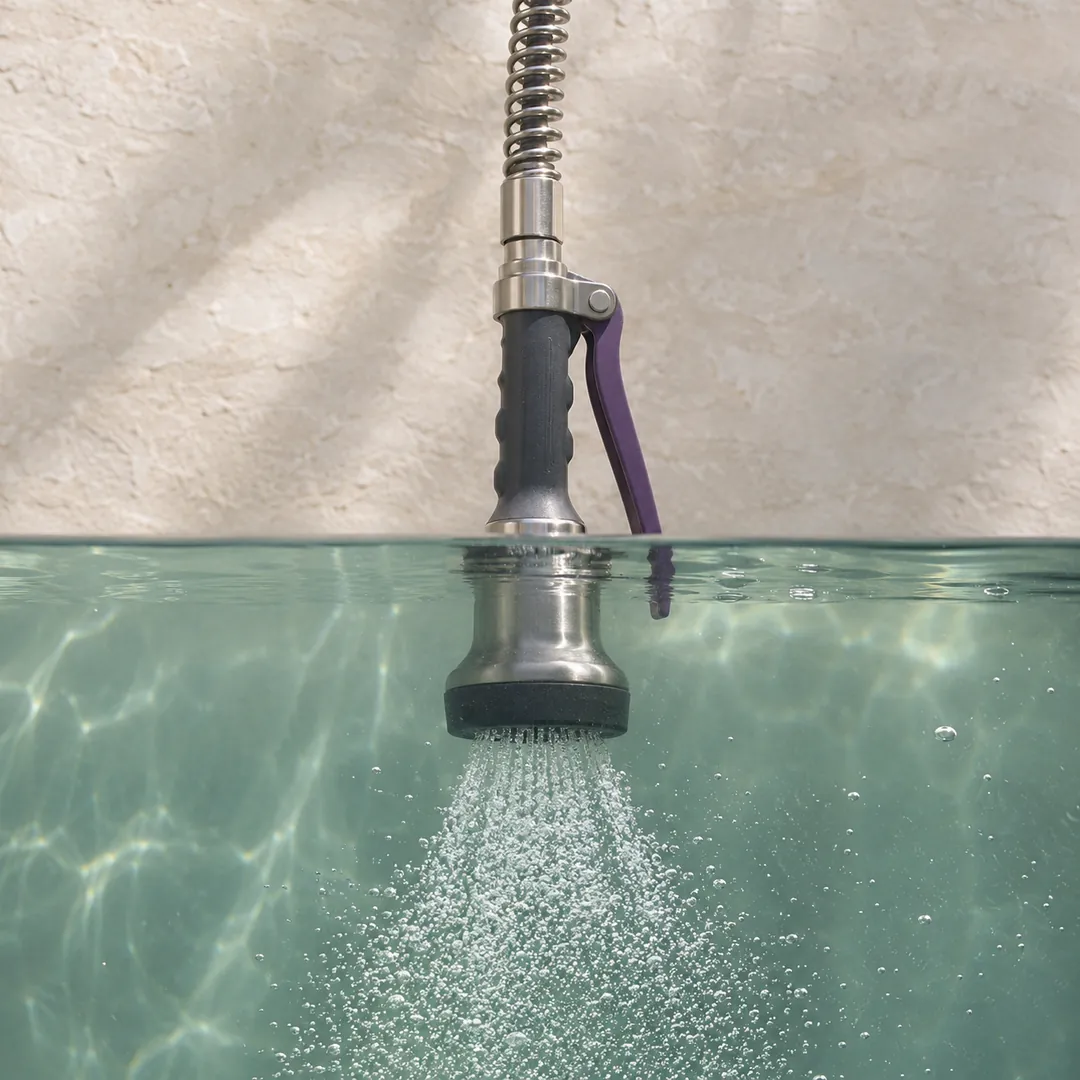
A pre-rinse spray valve is the handheld nozzle on a hose that blasts food off plates before they go into the dish machine. EPA’s WaterSense at Work guide says these valves can account for nearly one-third of the water used in a typical commercial kitchen, and calls replacement one of the most cost-effective projects a kitchen can do.
Federal law sets the maximum flow. Under 10 CFR 431.266, valves made from January 1, 2006 to January 28, 2019 were limited to 1.6 gpm, and valves made on or after January 28, 2019 are limited by spray force:
| Product class (spray force) | Maximum flow |
|---|---|
| Class 1: 5.0 ounce-force or less | 1.00 gpm |
| Class 2: more than 5.0 and up to 8.0 ounce-force | 1.20 gpm |
| Class 3: more than 8.0 ounce-force | 1.28 gpm |
EPA says valves made before 2005 can use 3.0 to 4.5 gpm, and that replacing a valve flowing 1.6 gpm or more with a compliant model gives a simple payback of less than a year for most facilities. It also says these valves typically cost less than $150, and that facilities typically run them no more than 200 minutes a day.
EPA’s fact sheet gives one measured result: a Boston University cafeteria cut its water use by more than 48,000 gallons a year, a 63 percent decrease, after installing high-efficiency pre-rinse spray valves. With water and sewer savings alone, EPA says a restaurant’s payback on replacing an old valve “could be as short as one month.”
You can measure your own valve in a minute. Hold the trigger open over a marked 1-gallon container and time how long it takes to fill: 60 divided by the seconds gives gallons per minute. A valve that fills the gallon in 20 seconds runs at 3.0 gpm.
EPA’s practical advice for keeping the savings:
- Choose the spray force the dishes need: lower force for light soil, higher for baked-on pans.
- Train staff to scrape plates into a bin before rinsing.
- Use the lock-open clip only when a steady stream is needed.
- Keep supply pressure between 20 and 80 psi and descale the nozzle.
- Do not drill out the holes, and avoid flow-restricting inserts on old valves; replace the valve instead.
The dish machine
A commercial dish machine washes and sanitizes ware with hot water and chemicals. EPA’s dishwasher guide says these machines can account for more than two-thirds of a commercial kitchen’s water use, and notes that there are no federal standards limiting the water or energy they use. EPA’s spray valve and dishwasher guides describe different kitchens, so their shares do not add up; together they say where the hot water goes.
The guide sorts machines by throughput. Undercounter machines often serve up to 50 meals an hour, stationary door-type machines 50 to 250, single-tank rack conveyors 250 to 400, double-tank conveyors 400 to 750, and flight-type machines 750 or more.
Sanitizing method changes the water and energy picture. Low-temperature machines wash at 120°F to 140°F with a final rinse at 140°F and use chemical sanitizers. High-temperature machines wash at 150°F to 160°F with a final rinse at 180°F, usually through a booster heater, so they use more energy but less water and fewer chemicals.
ENERGY STAR says certified commercial dishwashers are about 50 percent more water efficient and 12 percent more energy efficient than standard models. EPA adds that certified high-temperature rack and conveyor machines are held to between 0.54 and 0.89 gallons per rack, and low-temperature models up to 1.19 gallons per rack. At Shari’s, EPA reports, new ENERGY STAR machines cut water from 3.2 to 1.8 gallons per cycle.
Before replacing anything, check how the current machine is run. EPA’s operating advice includes running only full racks, keeping final rinse pressure near the manufacturer’s setting (about 20 psi for most machines), setting the rinse time to the manufacturer’s minimum, turning machines off at night, repairing worn rinse nozzles and checking that conveyor rack sensors stop the water when no dishes are present.
Ice machines, steamers and combination ovens
These three are usually replacement decisions, not quick fixes, but the gap between old and efficient models is wide. The ice machine is the one to look at first in a hot Southern kitchen, because a water-cooled unit can draw more water than any other single machine.
Ice machines
An ice machine uses water twice: to make ice and, in water-cooled models, to carry heat away from the refrigeration system. EPA’s ice maker guide says single-pass water-cooled machines use 100 to 300 gallons per 100 pounds of ice, while air-cooled machines use less than 50.
EPA says air-cooled machines suit most commercial settings, with at least 6 inches of clearance and surrounding air at 80°F or less. Water-cooled machines should be used only where the room stays hotter than that or clearance is too tight, and then on a closed loop rather than single pass. In a hot Mississippi kitchen that air temperature limit is a real constraint. EPA notes that remote condensing units transfer the heat outside the building; the equipment supplier can say which configuration suits your room.
ENERGY STAR says certified batch-type (cube) ice makers are about 20 percent more water efficient and 10 percent more energy efficient than standard models; water-cooled machines are not eligible. EPA adds two operating points: size the machine to the ice you actually use, and set the rinse cycle to the lowest frequency that still gives acceptable ice. Filters, scale and cleaning are a separate subject, covered in our article on ice machine water filters, and what to do with ice during a notice is covered in whether a restaurant can stay open during a boil water notice.
Steam cookers
A steam cooker cooks food in a closed compartment of steam. EPA says inefficient boiler-based steamers can use up to 40 gallons an hour, efficient boiler-based models 5 gallons an hour or less, and connectionless models typically 3 gallons an hour or less. Boiler-based units also use water to cool condensate below 140°F before it reaches the sewer.
ENERGY STAR puts certified steam cookers at up to 90 percent more water efficient than standard models. EPA’s operating tips are simple: cook in full batches, keep doors closed, use only the compartments you need, and let a timer return the unit to standby.
Combination ovens
A combination oven cooks with steam, convection heat or both. EPA’s combination oven guide says boiler-based models can use more than 20 gallons per cooking cycle in steam mode, while ENERGY STAR certified models use 10 gallons or less. Certified models use no more than 0.5 gallons per pan per cycle in steam mode and 0.4 in convection mode.
Staff habits matter here too. EPA recommends using steam and combination modes sparingly, favoring convection mode where the food allows, keeping doors shut and loading the oven fully.
Restrooms, hand sinks and the rest of the building
Restrooms are about 31 percent of restaurant water, so they matter, but the gain depends on what is installed now. Toilets made since 1994 already meet the federal 1.6-gallon limit, so replacing them saves less than replacing a 3.5-gallon model.
| Fixture | Older or federal baseline | Efficient option |
|---|---|---|
| Toilet | 3.5 to 5.0 gpf (older); 1.6 gpf federal limit | WaterSense labeled: 1.28 gpf or less |
| Urinal | 1.5 to 3.5 gpf (before 1994); 1.0 gpf federal limit | WaterSense labeled: 0.5 gpf or less |
| Public restroom faucet | Often 2.0 to 2.5 gpm in existing buildings | 0.5 gpm (ASME A112.18.1/CSA B125.1) |
| Kitchen or prep faucet | 2.2 gpm federal limit | Aerator or laminar device at 1.5 gpm or less, or a foot valve |
| Wash-down hose | 7 gpm; heavy-duty 9 to 20 gpm | Self-closing nozzle; water broom at about 1 gpm |
The toilet and urinal figures come from EPA’s WaterSense at Work guides for toilets and urinals; gpf means gallons per flush. The faucet figures come from EPA’s faucet guide, which says many public-use faucets still run at 2.0 to 2.5 gpm despite the 0.5 gpm model code requirement. The hose and water broom figures come from NYC DEP’s guide.
Shari’s shows what cheap restroom and sink work can do across many stores. EPA reports that the chain put aerators on all 520 sinks at about $8 per faucet, with kitchen aerators at 1.5 gpm and bathroom aerators at 0.5 to 1.0 gpm, saving about 5 million gallons a year.
Sensor-operated faucets and flush valves need checking too. EPA’s restaurant fact sheet recommends confirming that automatic sensors on faucets, toilets and urinals work properly, because a sensor that misfires runs water nobody uses.
Where water reuse fits in a restaurant
For most restaurants, reuse comes last or not at all. EPA’s alternative water guide defines gray water as water from lavatory sinks, laundries and bathing, and says it excludes wastewater from kitchen sinks, so the kitchen’s largest flows are not candidates.
What remains is small in most restaurants. Landscaping is about 4 percent of use and cooling and heating about 1 percent in EPA’s shares, so rain or air-conditioning condensate sent to irrigation rarely moves the bill much. A restaurant in a larger building with a big roof, several rooftop units or a cooling tower is different, and a water review screens that question with numbers rather than assuming it.
A ranked audit: the Tallowtree Grill
The order that usually makes sense is: stop flows nobody uses, change cheap hot-water fixtures, then replace equipment when it is due. A worked example shows how that order plays out in gallons and dollars.
Example (fictional). The Tallowtree Grill is a fictional 120-seat full-service restaurant on JXN Water, open every day. Its bills average 4,500 gallons a day, about 180 CCF in a 30-day month. A walk-through with a bucket, a timer and the equipment list estimates where that water goes:
- Two continuous dipper wells at 0.35 gpm each, running hot through a 14-hour service day: 588 gallons a day.
- A pre-rinse spray valve from before 2005, measured at 3.0 gpm, used about 150 minutes a day: 450 gallons.
- A door-type dish machine using 1.6 gallons per rack for 200 racks a day: 320 gallons.
- A single-pass water-cooled ice machine making 400 pounds a day at 150 gallons per 100 pounds (from its specification sheet): 600 gallons.
- Thawing at a prep sink at 2.2 gpm for about an hour a day: 132 gallons.
- Toilets at 1.6 gpf for about 300 flushes a day: 480 gallons.
- Restroom faucets at 2.2 gpm, about 300 uses of 15 seconds: 165 gallons.
- One toilet with a misaligned flapper leaking 0.2 gpm around the clock: 288 gallons.
- Everything else (prep sinks, kettles, cooking, mop sinks, hand sinks, cleaning): about 1,477 gallons.
The kitchen share here is higher than EPA’s 52 percent average, mostly because of the dipper wells and the water-cooled ice machine. Every number in this example is a planning assumption for a fictional restaurant, not a measurement.
The table ranks the fixes for the fictional Tallowtree Grill in the order a manager would do them. Each value uses a single price of $20.00 per 1,000 gallons for water and sewer, plus $9.97 per 1,000 gallons of hot water for gas heating, over 365 days.
| Order | Measure | Gallons a day saved | Hot water? | Value a year | When |
|---|---|---|---|---|---|
| 1 | Replace the leaking flapper | 288 | No | about $2,102 | This week |
| 2 | Restrict both dipper wells to 0.2 gpm | 252 | Yes | about $2,756 | This week, with the health inspector’s agreement |
| 3 | Thaw in the walk-in on a schedule | 132 | No | about $964 | This week |
| 4 | Replace the spray valve with a 1.28 gpm model | 258 | Yes | about $2,822 | This month |
| 5 | Fit 0.5 gpm restroom faucet aerators | 128 | Counted as no | about $931 | This month |
| 6 | Replace the ice machine with an air-cooled ENERGY STAR model at 20 gal per 100 lb | 520 | No | about $3,796 | When due, or sooner if bids justify it |
| 7 | Replace the dish machine with a model rated 0.8 gal per rack | 160 | Yes | about $1,750 | At lease renewal or replacement |
| 8 | Replace toilets with 1.28 gpf models | 96 | No | about $701 | At the next restroom remodel |
The five quick fixes in the fictional example save about 1,058 gallons a day, about 23.5 percent of use, without buying any major equipment. The three replacements add about 776 gallons a day. The single largest saving is the ice machine, but it comes last in time because it costs the most and should be priced against contractor bids, its energy use and the heat it would add to the kitchen.
What the ranking rules are
The order in the example follows a few rules that work for most restaurants:
- Fix what wastes water around the clock first. Leaks and continuous flows cost the same at 3 a.m. as at noon.
- Then go after hot water. A gallon saved at the spray valve, dish machine or dipper well also saves energy.
- Then do the cheap fixtures. Spray valves and aerators cost little and pay back fast, according to EPA’s own estimates.
- Replace equipment when it is due. Ice machines, dish machines, steamers and combination ovens are bought on a cycle; write the efficient specification now so the next purchase meets it.
- Remodel restrooms last. Unless toilets are pre-1994, the gain per fixture is small.
How to price savings on a Jackson bill
On a JXN Water bill, water and sewer are both charged from the water meter, so every gallon saved lowers both. JXN Water’s rate page says “Water and sewer services are based on water meter readings”, with combined rates from March 23, 2026 of $7.48 per CCF for the first 50 CCF a month, $14.96 from 51 to 150 CCF, $17.45 from 151 to 350 CCF and $19.95 above 350 CCF.
Savings come off the top of the bill. Reading the rate table as an inclining block schedule, where each rate applies to the use within its block, the fictional Tallowtree Grill’s usage charge at 180 CCF is about $2,402 a month. The quick fixes bring it to about 138 CCF and about $1,692, a drop of about $710 a month, plus about $153 a month of gas for the hot water no longer heated.
The table above priced every gallon at $20.00 to keep the ranking simple. On the actual bill, the first 30 or so CCF saved each month come off the 151 to 350 CCF block at about $23.33 per 1,000 gallons, which is why the bill-based figure is slightly higher.
Three things do not change. The monthly availability charge depends on meter size, from $40 for a 5/8-inch meter to $320 for a 2-inch meter, and does not fall when you use less. Rates change, so use your latest bill. If you are outside Jackson, use your own utility’s water and sewer rates, and ask whether sewer is billed on water use or on a separate measure.
The water savings calculator was built for reuse projects, but its arithmetic works the same for efficiency: enter the gallons a day saved, the days you are open, your top block rate, any added operating cost and what the work costs. The water use calculator estimates fixture use from people and flow rates; for a restaurant, enter staff and guests as people, set showers to zero and use dish machine racks per week as dishwasher loads, then compare the total with your bill.
What to do this month
You can do most of this audit yourself in a week with a bucket, a timer, the meter and the equipment list. Here is the order.
- Turn twelve months of bills into gallons a day and gallons per cover, as described above.
- Read the meter at closing and an hour later with every fixture and flow-through appliance off. Then turn appliances on one at a time to see which ones move it.
- Dye-test every toilet tank and listen for running fill valves.
- List every continuous flow: dipper wells, scrap collectors, wok cooling, steamer condensate, thawing sinks and any water-cooled condenser. Write down hours and flow for each.
- Time the pre-rinse spray valve with a 1-gallon container and replace it if it runs above the federal limit for its class.
- Check dish machine settings against the manufacturer’s rinse time and pressure, and confirm racks go in full.
- Read the ice machine’s nameplate or specification sheet to learn whether it is air-cooled or water-cooled and what it draws per 100 pounds.
- Write an equipment replacement list with the efficient specification for each item, so the next purchase is the efficient one.
- Price the results at your top block rate and your energy rate, and check the next two bills against your estimate.
If you want a second set of eyes, a water review covers bills, meters, fixtures and equipment, a walk from the meter to the roof, and a ranked list of findings in order of cost, starting with leaks and fixtures. Our page on restaurants and food service explains how drinking water treatment for ice and beverage lines fits alongside this work, and the commercial water section of the journal collects related articles. When you are ready to talk about your building, write to us with your last twelve bills.